
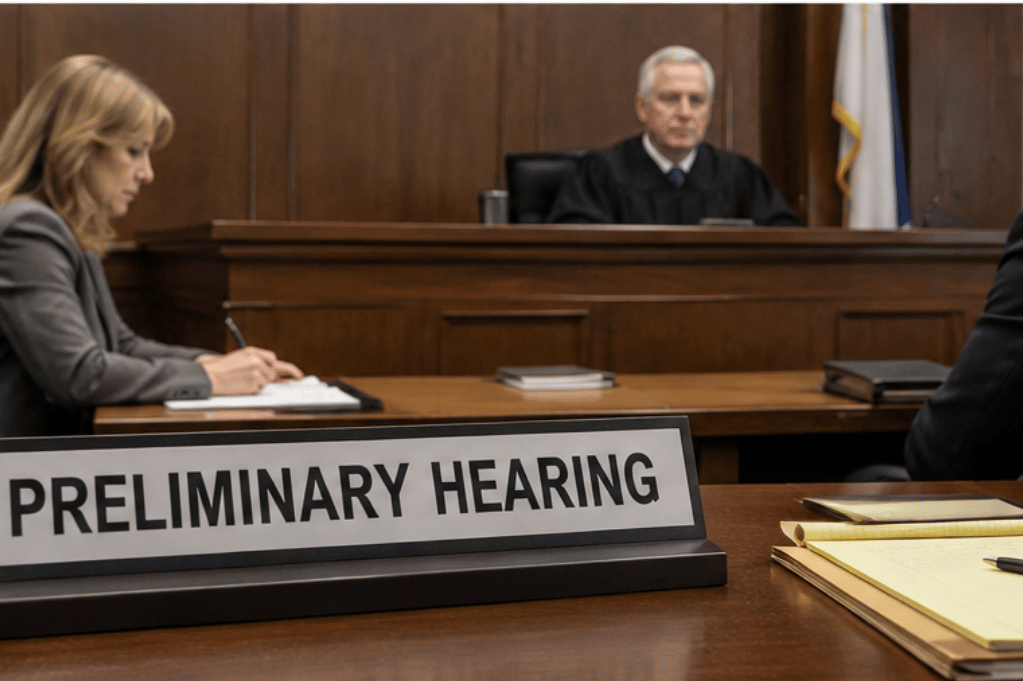
A preliminary hearing is a court proceeding that tests whether prosecutors have sufficient evidence to move a criminal case toward trial. It does not decide whether the defendant is guilty.
Short answer: This is a pretrial probable-cause check, not a trial. The prosecutor must present sufficient evidence for a judge to find that a crime occurred and that the defendant may have committed it. If that burden is met, the case moves forward. If it is not, the complaint may be dismissed.
| Question | General answer |
|---|---|
| Main purpose | Decide whether probable cause supports the charge |
| Who decides? | A judge or magistrate |
| Who has the burden? | The prosecution |
| Is guilt decided? | No |
| Can witnesses testify? | Yes |
| Can the defense question witnesses? | Usually yes |
| Can the hearing be waived? | Often, yes. |
| Possible result | The case moves forward, charges change, or the complaint is dismissed |
| Federal timing | Generally within 14 days if detained and 21 days if not detained |
| Do state rules differ? | Yes, sometimes substantially |
Key Takeaways
- The hearing tests probable cause, not guilt beyond a reasonable doubt.
- Prosecutors usually present witnesses, documents, police testimony, or other evidence.
- Defense counsel can often cross-examine prosecution witnesses.
- Evidence rules can be less restrictive than they are at trial.
- A defendant may be able to waive the proceeding.
- An indictment can remove the need for this step in some cases.
- State criminal procedures and deadlines differ, so local rules control.
What Happens at a Preliminary Hearing?
The prosecutor normally presents enough evidence to establish two basic points. First, there is probable cause to believe that a crime occurred. Second, there is probable cause connecting the defendant to that crime. The government does not need to prove the entire case. It also does not need to satisfy the trial standard of proof beyond a reasonable doubt.
Witnesses may testify. Police officers may describe an investigation, and prosecutors may introduce documents, physical evidence, or other information allowed under local rules. Defense counsel can often question prosecution witnesses. The defense may also present evidence, though it is not always the best strategy.
The judge then decides whether the evidence meets the probable-cause threshold. That ruling determines whether the criminal prosecution can continue to the next stage. Readers dealing with criminal charges may also find News Stast’s guide to hiring an assault lawyer useful for understanding why representation can matter before trial.
Seven Things to Know Before You Go to Court
- The judge is not deciding guilt. The question is whether enough evidence exists to justify further proceedings. A case can survive this stage even when major factual disputes remain.
- Probable cause is a lower standard than proof at trial. Prosecutors do not need to establish every fact beyond a reasonable doubt. They only need enough evidence to support a reasonable belief that the accused committed the offense.
- The prosecution normally goes first. Prosecutors may call an investigating officer, victim, eyewitness, or another person with relevant information.
- Cross-examination can reveal important weaknesses. Defense lawyers may question witnesses about inconsistent statements, identification problems, missing evidence, or gaps in the investigation.
- Evidence rules may be looser than they are at trial. Some information that would face stronger objections before a jury may still be considered at this early stage.
- Waiving the proceeding may be an option. A waiver means the defendant gives up the court’s probable-cause review. Lawyers sometimes recommend this for strategic reasons.
- The judge’s decision is not the final result of the case. A finding of probable cause usually sends the case forward. Plea discussions, motions, discovery, arraignment, or trial preparation may follow.
How Probable Cause Differs From Proof at Trial
Probable cause asks whether there is a reasonable basis to continue prosecuting the case. It does not ask whether the government has already proven guilt. That difference matters because the prosecution’s burden at this stage is much lower.
A judge can find probable cause even when the defense has strong arguments for trial. The judge may also allow the case to continue despite conflicts between witnesses. At trial, prosecutors face a far greater burden. They must prove every required element of the charged crime beyond a reasonable doubt.
This difference explains why winning an early probable-cause challenge can be difficult. The prosecution only needs enough evidence to cross the threshold for continued proceedings.
Arraignment vs. Preliminary Hearing vs. Trial
These proceedings happen at different stages and answer different questions.
| Proceeding | Main question | Typical focus | Decides guilt? |
|---|---|---|---|
| Arraignment | What charges does the defendant face, and what plea is entered? | Charges, plea, counsel, scheduling, release issues | No |
| Probable-cause hearing | Is there enough evidence to continue? | Witnesses, evidence, probable cause | No |
| Trial | Has the prosecution proven the charge? | Full evidence, witnesses, defenses, legal instructions | Yes |
The exact order can vary by jurisdiction. Some states use different names for early criminal proceedings. Federal cases also have their own structure. A grand jury indictment, for example, can eliminate the need for a separate probable-cause proceeding under Federal Rule of Criminal Procedure 5.1.
What Evidence Can the Judge Hear?
The prosecution may rely on several types of evidence, depending on the jurisdiction:
- eyewitness testimony;
- police testimony;
- photographs or video;
- physical evidence;
- medical or laboratory records;
- statements connected to the investigation; and
- other evidence permitted by local procedure.
This stage is often narrower than a trial. The prosecutor may call only enough witnesses to establish the essential facts. The defense may use cross-examination to test the reliability of the testimony. A lawyer might ask how a witness identified the accused, when a statement was made, or whether important facts changed.
Preserving records also matters outside criminal prosecutions. News Stat’s guide on what to do after a car accident explains why photographs, reports, and witness information can become important in later legal proceedings.
Can a Defendant Waive the Hearing?
Often, yes. Waiving the hearing means the defendant agrees to let the case proceed without requiring prosecutors to establish probable cause at that stage. There can be tactical reasons to do this. A lawyer may want to avoid preserving testimony that prosecutors could later try to use. A waiver may also be connected to negotiations.
There are drawbacks, too. The defense loses the opportunity to question witnesses early and to examine part of the prosecution’s case. Waiving the hearing also forfeits the possibility of obtaining dismissal based on the prosecution’s failure to establish probable cause.
That is why waiver decisions should be made with defense counsel. The better choice depends on the evidence, local procedure, plea discussions, and trial strategy. For more criminal law material, readers can browse the NewsStact Law section.
What Happens If the Judge Finds Probable Cause?
The case continues. Depending on the court system, the defendant may be “bound over” to another court. Prosecutors may file another charging document, or the case may proceed toward arraignment, motions, plea negotiations, and trial.
A probable-cause ruling does not mean that the defendant has been convicted. It means only that the prosecution produced enough evidence for the case to continue. Many issues can remain unresolved. These may include identification, credibility, search-and-seizure disputes, forensic evidence, legal defenses, and the admissibility of evidence at trial.
For more criminal law material, readers can browse the News Stast Law section.
What Happens If the Judge Does Not Find Probable Cause?
The complaint may be dismissed, and the defendant may be discharged from that proceeding. That result does not always mean that the legal matter is permanently over. Rules differ by jurisdiction.
In some places, prosecutors may have other lawful ways to pursue charges. They may seek an indictment, refile charges under permitted circumstances, or take another step authorized by local law.
A lawyer familiar with the court can explain whether dismissal ends the matter or leaves open the possibility of further prosecution.
Federal Timing Rules for a Preliminary Hearing
Under Federal Rule of Criminal Procedure 5.1, published by Cornell’s Legal Information Institute, the hearing generally must occur within 14 days after the initial appearance for a defendant in custody. The deadline is generally 21 days for a defendant who is not in custody.
A judge may extend those deadlines in circumstances allowed by the rule. These are federal rules. Do not assume that the same timetable applies in state court. Each state can set its own deadlines, eligibility rules, terminology, and exceptions.
What to Do Before the Court Date
Read every document you received from the court and confirm the date, time, and location. Give your attorney any records that could matter. These can include messages, photographs, videos, witness names, receipts, location information, or documents tied to the accusation. More from us: What Is Bail Jumping.
Do not contact prosecution witnesses about their testimony unless your lawyer advises you otherwise. Ask counsel what the prosecution must prove, whether witnesses are expected, and whether waiver has been discussed.
If you do not have a lawyer, ask the court about your right to counsel and whether you may qualify for appointed representation. Criminal procedure can vary from one state to another. Advice for a federal case may not apply to a state prosecution.
Frequently Asked Questions
Yes. If the prosecution fails to establish probable cause, the judge may dismiss the complaint or the charges covered by the proceeding. Local law determines whether prosecutors can later pursue the matter through another lawful procedure.
No. An arraignment usually addresses the formal charges, the defendant’s plea, counsel, and scheduling. A probable cause proceeding focuses on whether sufficient evidence exists to continue prosecuting the case.
Usually not. The prosecution carries the burden of establishing probable cause. Whether a defendant should testify or present evidence is a strategic decision that should be discussed with counsel.
Sometimes. Early criminal proceedings may apply evidence rules that are less strict than those in trial proceedings. Federal procedure permits consideration of some material that could otherwise be subject to different restrictions before a jury.
There is no universal length. A simple hearing may be short, while a case involving several witnesses or complicated evidence can take longer.
A successful challenge can result in dismissal, but that does not always prevent prosecutors from pursuing the case through another lawful procedure. The answer depends on the jurisdiction, the reason for dismissal, and the charging options available.